
This blog post is a continuation of my story about my assignment in Japan, which, contrary to the original plans, is still ongoing. In the first part, I shared my initial impressions of the assignment, and in this sequel, I dive deeper into Japanese culture, language, and my experiences over the past two years.
I have now lived in Japan with my family for almost two years and have “become Japanese” without even noticing. Example: When boarding crowded vehicles in Japan, people always move their backpacks from their backs to their stomachs to take up less space and cause less disturbance to fellow passengers. This has become normal for me too. One morning after a bus ride, I noticed that my backpack had appeared on my stomach without me remembering moving it there.
For someone like me, who is used to the Finnish climate, the Japanese summer is quite challenging. July and August are particularly difficult, with temperatures hovering around 36 degrees every day. For example, you can’t take your children to the park because of the high risk of heatstroke, and being outside is generally uncomfortable. To protect themselves from the summer heat, Japanese people use some pretty unusual methods, like cooling neckbands (which have gel inside that melts at around 25 degrees) and jackets with built-in fans. Parasols are also really popular, especially among women. Although I consider myself a tough guy for cycling to work in Finland throughout the winter, you can spot me walking around with an umbrella (I haven’t invested in a parasol yet) in the middle of summer in Japan.
Blue traffic lights and other linguistic peculiarities
My Japanese is slowly improving, but small talk is still difficult when others speak in dialect and use words that are not part of my “how-to-survive-in-Japan” vocabulary.” The Japanese language has many peculiarities. For example, a green traffic light is called a blue traffic light (青信号, aoshingoo) in Japanese, because in ancient times, shades of green belonged to the blue category. Nowadays, the color green is of course recognized, but for some reason, the color of traffic lights remains blue in colloquial speech. Words that have no direct equivalent in English or Finnish also pose a challenge to learning. For example, there are about ten different verbs for the Finnish verb wear (to dress, in Finnish: “pukea”), because in Japanese, the verb changes depending on which part of the body the garment or object is put on.
Learning Japanese is made a little easier by the fact that the language has a lot of loanwords from English, e.g., hotel is “hoteru” (ホテル). These loanwords help you understand meetings better, as they are always written in katakana, which is much easier to read than kanji. The Japanese also like abbreviations, and even English loanwords are sometimes given unusual abbreviations, such as building – biru (ビル), don’t mind – donmai (ドンマイ).
One difficulty in learning the language is that Japanese has a lot of words with multiple meanings. In addition, first and second person pronouns are not used, as emphasizing one’s own actions is to be avoided and using “you” is considered rude. This lack of pronouns makes it particularly difficult for AI translators, as they have no way of determining which party is being referred to in a single sentence.
Work culture and attitude
Japanese work culture is known for long working days and perseverance. Fortunately, here at Murata, there are no strange rules that you have to be at the office before your boss and leave after them. Flexible working hours are in place, and overtime can be done at your own discretion. Overall, the work culture in Japan is undergoing a transition, and more and more attention is being paid to people’s well-being. However, changing attitudes and habits is a slow process.
Work and commitment to work are quite different in Japan. In busy situations, it is normal for Japanese people to work long hours to achieve their goals. Of course, Finns also work long hours, when necessary, but they try to avoid long hours through planning and prioritization. A short and efficient day may seem unhurried from a Japanese perspective and thus cause some cultural conflicts. In Japan, there is still a mindset that people who work longer hours are busier and more conscientious than those who leave work early. For the Japanese, commitment and being at work are important things, which is reflected in low unemployment rates, for example.
The unemployment rate is quite low in Japan compared to Finland (2024: 2.5% vs. 8%), partly because people are willing to work in jobs that do not exist in Finland. At gas stations, staff refuel cars without the driver having to leave the vehicle. Shopping center parking lots may have dozens of traffic controllers, and construction sites are guarded by several people. In Japan, working and contributing to society seems to be more important than in Finland, where individualism is strong.
Infrastructure maintenance is one of Japan’s major challenges, as the country has a rapidly aging population and a low birth rate. The median age in Japan is already 50 (43 in Finland), and about 30% of the population is over 65. Another challenge is that the Japanese have long postponed many issues related to digitalization. This can be seen, for example, in banking. For example, there are bills that cannot be paid electronically, but must be paid in person at a bank branch. Banks are only open on weekdays from 9 AM to 3 PM, which means that people have to take two hours off work to pay their bills. Another thing that Japanese people must take time off work for is renewing their driver’s license. Every driver’s license holder must renew their license by going to a driving school for about two hours once every three years. With approximately 80 million Japanese drivers, the renewal process takes up a considerable number of working hours each year.
As there has always been a supply of workers and people are willing to work uncompromisingly, there has been no need to reduce paperwork. In the future, however, there will not be enough labor to maintain all the infrastructure or tasks performed using paper forms. The government has also recognized this problem and taken action. Japan’s new prime minister said that the biggest challenge facing Japan is population decline. The world is watching closely to see how Japan will cope with this increasingly difficult situation, as Japan will serve as an example for other countries with low birth rates. I believe that a solution will be found and that its implementation will not be hindered by national unity and social values.
Outside of work
In Japan, I have particularly enjoyed the good and affordable food, the pleasant climate (except in summer), and nature. I especially like ramen noodles and yakiniku restaurants, where meat is grilled at the table. If you are concerned about food culture and traveling in Japan with dietary restrictions, I recommend taking a look at an article written by my wife on the website of the Finnish Celiac Association: Gluten-free living in Japan (In Finnish only).
In addition to cherry blossoms and autumn colors, the mountains are especially magnificent. The mountains are very steep, there are many of them, and hiking to the top of a mountain is an excellent hobby.
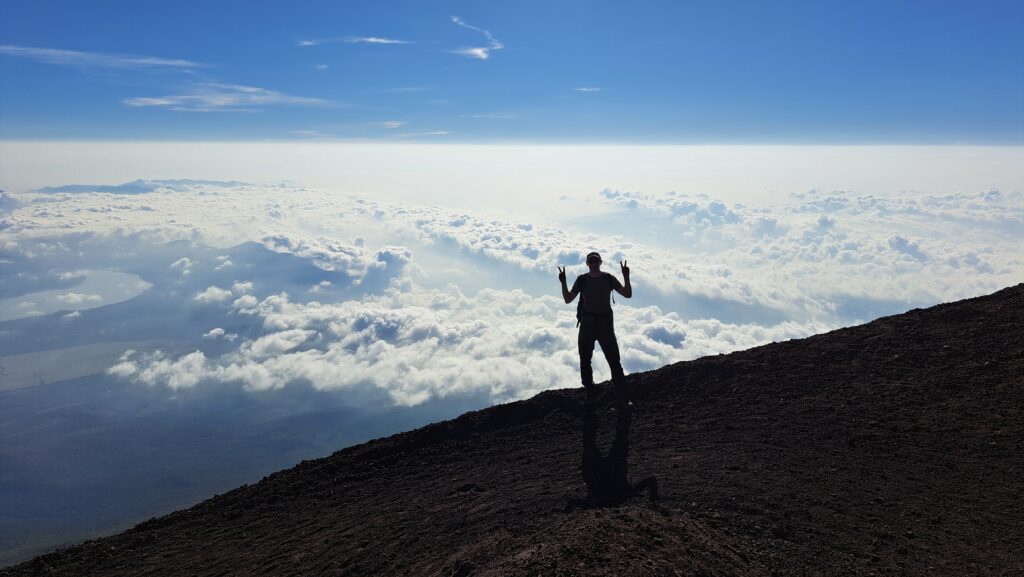
Mountains also have great significance for the Japanese, and some of them are considered sacred. The three most sacred mountains are called “san-rei-zan” and include Fuji (3776 m), Tate (3015 m), and Haku (2702 m). As Japan’s highest mountain, Fuji is naturally the best known, and there is even a special term for watching the sunrise from the summit of Fuji: “goraiko” ご来光. During my assignment, I was delighted to have the opportunity to climb these three mountains, and seeing goraiko was one of the most wonderful experiences of my life.
In Japan, the New Year is a time of calm (no fireworks, etc.), but a couple of weeks after the turn of the year, the temple near our home holds its annual “himatsuri,” or fire festival. In accordance with an 800-year-old tradition, young men dressed in minimal clothing run past huge fires to pray for health and protection from disease.
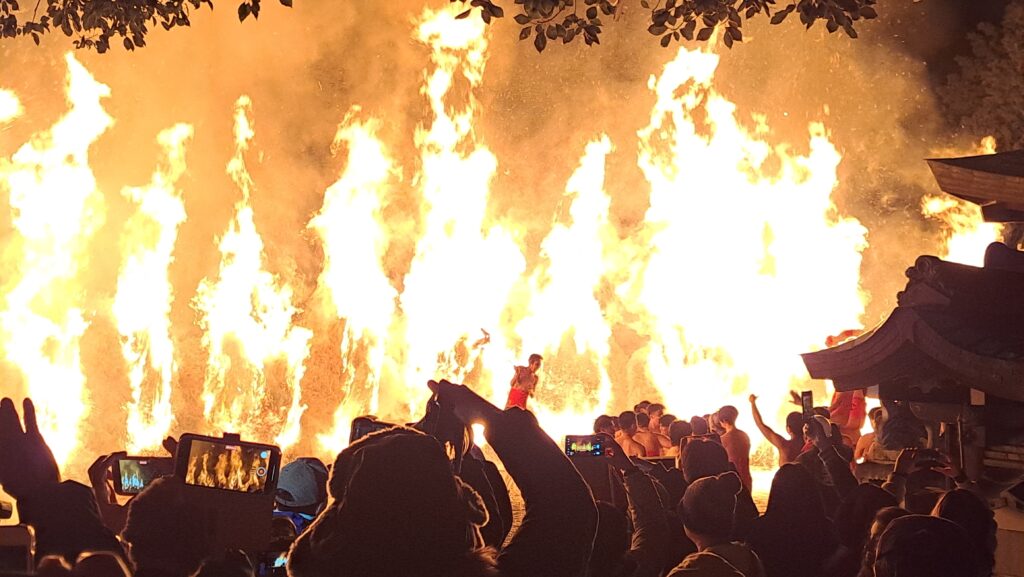
Happy New Year to everyone from Japan!
Pekka Lehtinen
Manager, Test Equipment Development
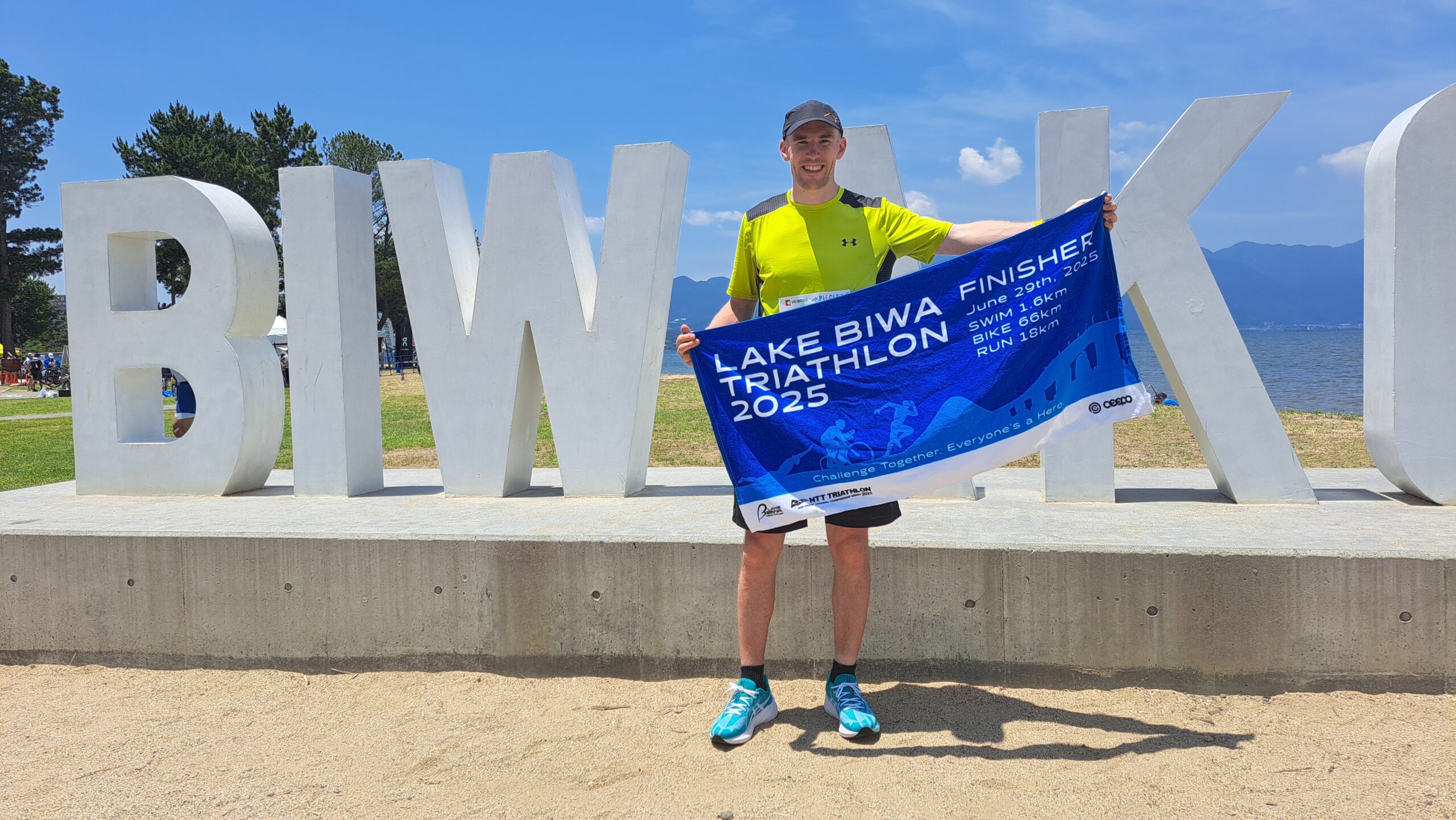
Cover photo: Successfully finished the Lake Biwa triathlon – despite the temperature (35°C)!



 English
  Finnish