
Have you ever had to squint your eyes when driving in the dark because of the headlights of an oncoming car? Momentary glare may seem insignificant, but even a second of impaired visibility can cause a serious traffic accident. A pedestrian, cyclist, or winding road may go unnoticed just when visibility is most important.
Improving traffic safety is a key social goal, with the primary aim of reducing traffic fatalities and serious injuries. Modern technology plays an increasingly important role in this: safety is no longer improved solely by vehicle design and passive safety systems, but increasingly by intelligent, situation-adaptive electronics.
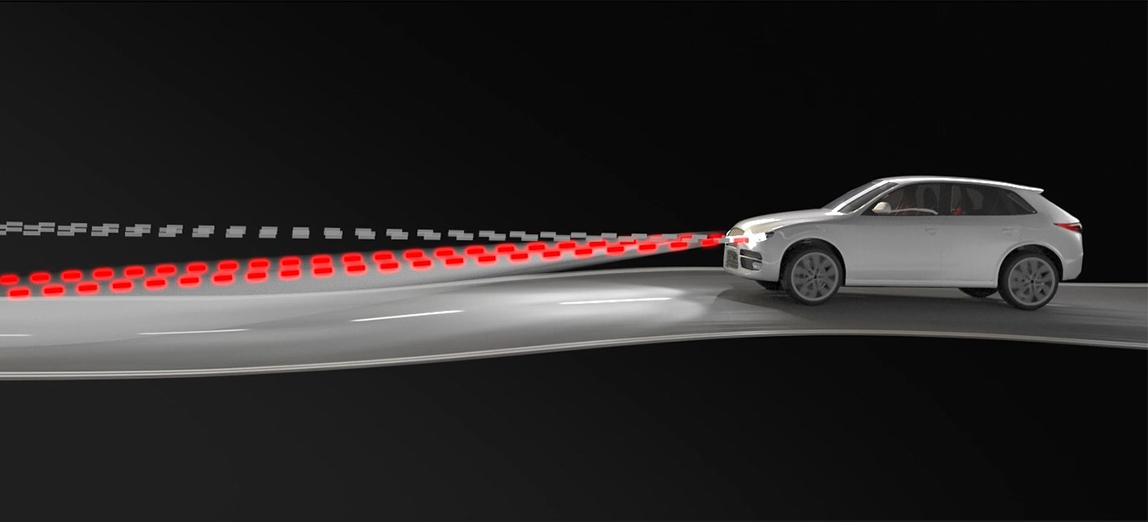
One concrete example of this development is automatic headlight adjustment, where the height of the beam is adjusted according to the load or position of the car.
Regulation drives development
In the coming years, vehicles will have to meet stricter requirements for headlight levelling, and automatic height adjustment to compensate for the effect of load will become mandatory in all new cars. This will drive car manufacturers to adopt more cost-effective and reliable solutions than those currently available.
The regulatory requirement is to compensate for the effect of vehicle load, but a more advanced approach is to adjust the height of the lights in response to acceleration, braking, or road irregularities. Automatic adjustment prevents oncoming traffic from being dazzled and ensures that the driver always has the best possible visibility when driving in the dark – it’s important that the driver will be able to detect pedestrians early enough.
At the same time, headlight technology is advancing rapidly. Alongside traditional headlights, adaptive LED, and megapixel headlights have emerged, allowing the light distribution to be adjusted dynamically while driving. These systems, for example, make it possible to selectively shade oncoming vehicles without plunging the rest of the road into darkness. For such headlights to function correctly, their direction must be adjusted continuously and dynamically. Even small changes in the vehicle’s posture affect where the precise light beam is directed.
Sensor technology at the heart of development
Modern headlight levelling systems are based on continuous measurement of the car’s movement and position and advanced inertial calculation. Murata’s high-performance MEMS* inertial sensors offer an excellent solution for this.
The sensor measures movement, and an application based inertial algorithm generates real-time information that can be used to adjust the headlights. Inertial calculations can be used to determine, for example:
- how much the front of the car squats or dives as a result of load, acceleration, or braking
- whether the car’s position changes due to road inclines or unevenness
- whether the vehicle is traveling straight or slightly skewed in relation to the road.
Based on this information, the headlights can be adjusted precisely both statically (load compensation) and dynamically according to the driving situation. The result is better visibility for the driver and less glare for other road users.
Murata’s solution for automatic headlight alignment
Murata’s solution for headlight alignment applications is based on MEMS* motion sensor technology and advanced algorithms. The solutions utilize a 3-axis acceleration sensor or a 6-axis SCH1600 IMU**.
The SCH1600 sensor can be used in this application in so-called integrated cases, where the sensor is already in the car for ADAS applications, such as precision positioning. The sensor was developed and manufactured at Murata’s factory in Vantaa.
Our solution is of interest to automotive industry players around the world, as it also enables a simpler car configuration compared to traditional suspension sensor-based solutions. This simultaneously improves safety, system quality, and cost-effectiveness.
Technology increases safety
Automatic headlight levelling is a good example of how technology can improve road safety with every kilometer driven. When a vehicle’s sensors, algorithms, and systems work seamlessly together, the driver has better visibility and other road users are protected from glare.
The sensor solutions developed by Murata support this development by providing reliable measurement data in situations where it matters most – when safety is decided in seconds.

Pekka Kostiainen
Sr. Business Development Manager
*MEMS = Microelectromechanical Systems
**IMU = Inertial Measurement Unit




 English
  Finnish